Chief of Training!
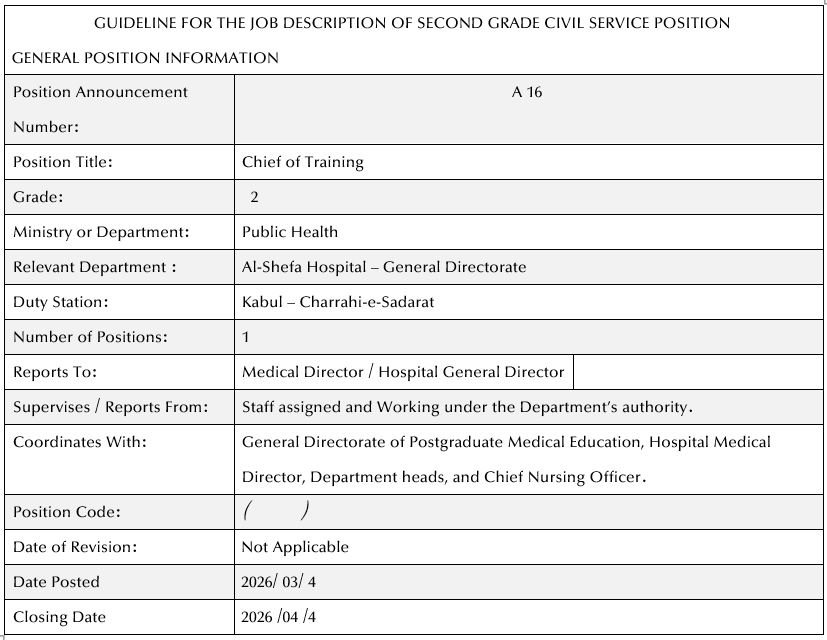
Publish Date
Closing Date
Job Purpose / Objective:
The Training Chief or Head of Educational Programs is responsible for the strategic leadership and oversight of all hospital educational programs. This role ensures that the hospital remains at the forefront of medical education, including the management of undergraduate and postgraduate training programs, Continuing Medical Education (CME), faculty development, and academic collaboration with educational institutions. The Training Chief works closely with medical, administrative, and educational leadership to foster a culture of excellence in education, research, and patient care, in full compliance with health requirements and regulations, and to ensure that departmental training programs are aligned with the hospital’s overall mission, vision, and strategic objectives. ............................................................................
Duties and Responsibilities:
Core Duties:
Integration of Clinical Activities:
- Ensure that the content of hospital educational programs reflects recent clinical research and evidence-based practices.
- Encourage and integrate educational initiatives that enhance clinical outcomes and patient care.
- Promote an environment where education and patient care are conducted simultaneously.
- Model and teach professionalism through collaborative interaction with other clinical team members, patients, and their families.
- Supervise the implementation of continuous professional development programs for clinical staff through lectures, educational materials, and hands-on training.
- Ensure that educational programs comply with medical regulations, accreditation standards, and hospital policies.
Leadership and Strategy Development:
- Develop and implement an educational strategic vision aligned with the hospital’s mission and values.
- Lead and oversee the development of educational curricula for medical students, trainees, fellows, and other healthcare staff.
- Collaborate with the senior leadership team to set educational priorities that support the hospital’s overall objectives.
- Initiate and support the integration of education with clinical services and research activities.
- Work closely with senior leadership to align educational activities with patient care objectives.
- Define short-term and long-term academic responsibilities for visiting medical personnel from abroad.
Faculty Development:
-
- Leading programs for recruitment, retention, and development of academic staff.
- Designing and implementing programs to support academic staff (faculty) in excellence in teaching, participation in research activities, and professional growth.
- Promoting a culture of mentorship or coaching and academic advancement among academic staff.
- Providing guidance on integrating educational research into clinical and academic activities.
Quality Improvement and Evaluation:
-
- Developing and implementing continuous quality improvement (CQI) programs in the education department
- Monitoring and evaluating educational programs through feedback collection from students, faculty, and other stakeholders.
- Utilizing evaluation data to improve curriculum, teaching methods, and program effectiveness.
- Publishing educational research and case studies to contribute to the advancement of medical education.
Program Management & Oversight:
-
- Overseeing the planning, implementation, and evaluation of educational programs for medical students, trainees, fellows, and departmental staff.
- Managing continuing education programs, workshops, and seminars for healthcare staff.
- Coordinating inter-professional education (IPE) initiatives and promoting collaboration among different disciplines such as nursing, pharmacy, and other allied health professionals.
- Leading the development and enhancement of simulation-based training and other teaching methods.
- Reviewing and ensuring compliance with all academic or scientific accreditation requirements.
Regulatory Compliance & Accreditation:
-
- Ensuring adherence to all applicable rules and regulations in the implementation of educational programs.
- Leading and managing educational activities to maintain accreditation status and comply with legal and regulatory requirements.
- Preparing and leading audits for educational and training purposes, maintaining high standards during hospital inspections and supervisory visits.
- Regularly reviewing and updating research protocols to align with evolving standards and regulations.
Collaboration and Stakeholder Engagement:
-
- Acting as a liaison between the hospital and academic educational institutions, professional bodies, and other educational authorities.
- Establishing and maintaining relationships with educational stakeholders, such as universities, government departments, and professional health associations.
- Working closely with department heads, clinical teams, and educational committees to integrate educational opportunities into practical clinical activities.
Financial and Resource Management:
-
- Developing and managing budgets for educational programs, ensuring effective allocation of resources.
- Pursuing funding opportunities for educational grants and initiatives.
- Monitoring and reviewing resource utilization to maintain a sustainable educational environment.
- Planning and organizing monthly, quarterly, annual, and strategic plans for hospital educational programs in collaboration with department heads to improve hospital education, clinical outcomes, and patient and trainee satisfaction.
- Preparing and collecting teaching materials according to the planned educational programs.
- Providing monthly, quarterly, annual, and ad-hoc reports on educational activities to the Chief of Staff, Hospital Directorate, and General Directorate of Postgraduate Education.
- Participating regularly and actively in forums convened by the General Directorate of Postgraduate Education in coordination with the Hospital Directorate.
- Performing other duties assigned by the Hospital Directorate in accordance with laws, regulations, hospital objectives, and the Ministry of Public Health.
……….......................................................................................................
Employment Requirements / Qualifications:
- Must be a citizen of Afghanistan.
- Age must be between 35 and 60 years.
- Educational Qualifications:
- MD/equivalent Medical degree or advanced degree in education in teaching or healthcare management from recognized institutions approved by the Ministry of Higher Education.
- Postgraduate specialization or fellowship in clinical areas is preferred.
- Work Experience:
- At least 5 to 7 years of successful experience in medical education, with a minimum of 3 years in a leadership or managerial role.
- Proven experience in curriculum development, faculty development, and accreditation processes.
- Experience in multidisciplinary clinical environments, preferably in a teaching hospital or academic medical center.
- Successful track record in developing and supervising effective educational programs.
- Strong clinical and practical background, with direct experience in teaching within hospital or academic educational settings.
- Practice License:
- Possession of a valid medical practice license from the Medical Council.
- Required Skills and Competencies:
- Proficiency in one of the national official languages (Pashto or Dari).
- Computer skills in relevant programs and applications.
- Ability to foster and strengthen collaboration among diverse groups of faculty, staff, and students.
- Expertise and experience in educational technologies and innovative teaching methods (e.g., simulation and online education).
- Deep understanding of accreditation requirements and regulations related to medical education.
- Research experience in educational outcomes and quality improvement.
- Ability to balance educational, clinical, and research responsibilities effectively.
- Strong leadership, management, and interpersonal communication skills.
- Ability to communicate effectively in English (writing, speaking, and reading).
- Ability to actively participate in strategic planning and effective implementation of departmental goals.
- Commitment to innovation, academic excellence, and patient-centered care.
- Demonstrating integrity and adherence to professionalism in all interactions with patients, their families, and other hospital staff.
- Ability to accept mistakes, take responsibility, and work effectively in a multidisciplinary team.
7. Key Performance Indicators (KPIs):
- Number of educational programs conducted annually for doctors, nurses, and healthcare staff.
- Percentage of staff participation in refresher and professional development programs.
- Faculty-to-trainee ratio in clinical departments.
- Number of scientific research projects and publications by faculty and trainees.
- Level of student and trainee satisfaction with the quality of education and learning facilities.
- Number of articles published in reputable journals and presentations delivered at conferences annually.
- Percentage of trainees who have completed key skills according to the educational plan.
- Percentage of participation in Mortality & Morbidity (M&M) review meetings.
Submission Guideline
Electronic applications will be sent to: sub e-mail which corresponds if any of following 2 items
is missing, your application will be considered as ineligible/incomplete.
1. In your emails please specify the title of the position as well as vacancy number for electronic submissions .
2. Please submit your updated CV along with copies of your academic credentials and documents supporting your professional experience.
Kindly ensure that your résumé clearly indicates the exact dates and duration of each position held, as well as your precise date of graduation (month, and year).
If you are shortlisted and invited for written test/interview you will be required to present the original, the following:
• Electronic applications will be sent to: sub e-mail
• The Contact Person at Human Resources is:, HR Officer, MoPH-GD HR. Phone number: 0093- (0)-202312422
Note:
- The salary and benefit is paid according to the organization special salary scale
Only shortlisted candidates will be invited to written test/interview and subsequent
• No CVs will be accepted after the closing date.
قابل ذکره است متخصصین محترم که عملآ در شفاخانه های دولتی اجرای وظیفه می نمایند بنابر ایجاد سکته گی در امورات قبلی شان و جلوگری از متضرر شدن سکتور صحی دولتی در بست های شفاخانه الشفا قابل شارت لست نمی باشند.
Submission Email